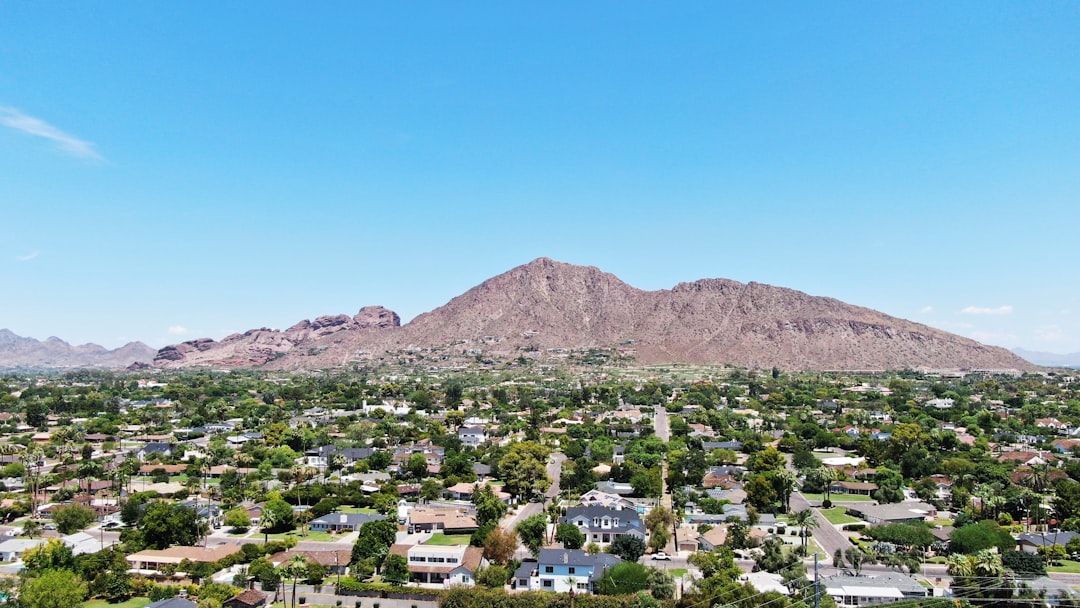
In Phoenix, two homes priced identically, sitting five miles apart, can feel like completely different climates. One subdivision bakes at 112°F all afternoon. Another — same city, same summer — rarely breaks 97°F at street level. The difference usually isn’t the houses. It’s the trees.
Specifically, it’s urban tree canopy — and in the Phoenix metro, its presence (or absence) is one of the most underappreciated factors in both livability and long-term home value.
The Science Is Real, and the Gap Is Enormous
Urban heat island effect gets talked about a lot in general terms. But the numbers in Phoenix specifically are striking. According to research from Arizona State University’s Urban Climate Research Center, neighborhoods with dense mature tree canopy can register surface temperatures 10 to 15 degrees Fahrenheit cooler than nearby neighborhoods with little to no shade. Some studies measuring asphalt and exposed soil surface temps push that gap even higher.
This isn’t just ambient air temperature, either. It’s radiant heat — the kind you feel walking from a shaded sidewalk to a sun-baked parking lot. In a city where June ground surface temps on unshaded pavement regularly exceed 150°F, shade is the difference between functional outdoor space and a place nobody goes between 10 AM and 7 PM.
Evapotranspiration is the mechanism driving most of it. Trees and vegetation release moisture into the air, cooling the immediate environment through a natural evaporative process. In a desert city that’s been replacing natural desert vegetation with concrete and low-water landscaping for decades, that mechanism gets stripped out neighborhood by neighborhood.
Where This Shows Up in Phoenix Real Estate
Drive through the older residential neighborhoods of central Phoenix — areas like Arcadia, Willo Historic District, or Coronado — and you’ll immediately notice the difference. Mature citrus trees, old mesquites, and 40-year-old desert willows create a canopy over entire streets. Some Arcadia blocks along the canals feel practically lush. Surface temps drop noticeably just turning off a major arterial.
Now drive through a mid-2000s master-planned community built during the fast-growth years — wide streets, minimal landscaping, rock yards, young or no trees — and the contrast hits you physically.
The correlation with home values is real. As of recent market data, homes in Arcadia zip codes like 85018 carry median prices well above $800,000 — a premium that reflects multiple factors, but livability and shade are baked into that equation. Buyers who’ve done a summer in a treeless subdivision understand exactly what they’re buying into.
If you’re thinking about the broader market dynamics at play, it’s worth reading about what Phoenix buyers are getting for their money at the luxury level — canopy-rich neighborhoods are one reason some price premiums hold even when the broader market softens.
What to Look for When Evaluating a Neighborhood
Most buyers don’t have time to commission a canopy study. Here’s a practical framework for reading this on the ground:
Signs a neighborhood retains cooler temperatures:
- Mature tree coverage over at least 30–40% of street surface
- Presence of irrigation infrastructure (canal-adjacent lots, older flood irrigation areas in Arcadia and parts of Gilbert)
- HOAs or city programs actively maintaining public tree canopy
- North-south oriented streets with trees on east/west sides (more effective shade)
- Grassy common areas and parks within a quarter mile
Red flags for heat retention:
- Wide arterials with no tree buffer between the street and homes
- Predominantly rock or decomposed granite front yards with no canopy trees
- Development built after 2000 in outer West Valley areas with minimal landscaping requirements
- Low street tree density visible on Google Street View (do this before every showing)
One quick trick: pull up a satellite view in Google Maps at noon on a summer day and look at shadow coverage. You can see tree canopy clearly. If the neighborhood looks mostly beige and grey with minimal dark shadow patches, that’s telling you something.
The Energy Bill Factor (And What It Does to Ownership Costs)
Here’s where this gets directly financial. Arizona Public Service and Salt River Project both publish data showing that a well-shaded home can reduce cooling costs by 20 to 30% annually. In a Phoenix-area home running the AC from April through October — and sometimes year-round — that adds up fast.
A household spending $350/month on summer cooling could realistically save $70 to $100 per month in a canopy-rich neighborhood compared to a comparable home baking in direct sun. Over a 10-year ownership horizon, that’s $8,000 to $12,000 in energy savings. That’s real money that buyers rarely factor into their offer calculations.
This also shows up in buying conditions during peak heat — touring homes in July or August is actually one of the best stress tests you can run on a house and its surrounding environment.
New Construction vs. Established Neighborhoods: The Canopy Gap
This is one of the genuine tradeoffs of buying new construction in the outer suburbs — Surprise, Queen Creek, Buckeye, and parts of Peoria. The homes themselves are often better built, more energy efficient at the mechanical level, and come with warranties. But the land around them has been scraped clean and replanted with 5-gallon trees that won’t provide meaningful shade for 15 to 20 years.
Builders are increasingly aware of this. Some Arizona Builders Alliance member projects are incorporating more aggressive landscape standards and shade design into newer master plans — but the canopy gap between a 2024 subdivision and a 1985 Tempe neighborhood won’t close in any timeframe that matters to a buyer purchasing today.
What to Do With This Information
If you’re buying in the Phoenix metro, add canopy to your evaluation checklist. It’s not a soft preference — it’s a factor that affects your utility bills, your outdoor usability, your long-term health, and your home’s resale appeal as Phoenix summers intensify.
When you’re touring, arrive early or right at midday and stand outside for five minutes. You’ll feel the difference before you ever walk through the front door. If a street feels noticeably cooler than the arterial you turned off of, that’s the canopy working. If it feels the same, take note.
And when you’re negotiating price? A home in a treeless new subdivision and a home in a shaded, established neighborhood are not comparable properties — even if Zillow says they are.